The Stock Market:
Why this year has not been simple
Steve Saville
19 November, 2004
Below is an extract from
a commentary posted at www.speculative-investor.com on 7th November
2004
Albert Einstein said that we
should make things as simple as possible, but no simpler. And
when it comes to the stock market, you could have interpreted
the intermediate-term trend with considerable accuracy over the
past several years simply by knowing one thing: that the NASDAQ100
Index (NDX) moves higher relative to the Dow during the upward
trends and moves lower relative to the Dow during the downward
trends. By the same token, if you didn't know this simple guideline
then you would probably have been completely wrong-footed by
the market on multiple occasions, particularly if you made the
mistake of focusing on the absolute behaviour of the Dow Industrials
Index (the Dow tends to show relative strength near intermediate-term
tops and relative weakness near intermediate-term bottoms, so
someone who puts a lot of weight on what the Dow is doing will
probably be too bullish near the tops and/or too bearish near
the bottoms).
Actually, it hasn't been necessary
to monitor the performance of the NDX relative to the Dow to
properly interpret 'the trend,' but it has been necessary to
understand that the most important influence on the stock market's
3-12 month trend is whether market participants are becoming
more or less risk averse (NDX/Dow is just one way of measuring
changes in investors' preference for risk). For example, if the
performance of the US stock market during the late-1990s taught
us anything it was that there is no limit on how over-priced
a market can become provided that the risk tolerance of 'investors,'
as a group, is increasing.
Now, over the remainder of
this decade the US stock market will almost certainly not experience
anything like the total disregard for risk demonstrated by the
buyers of telecom, tech and internet stocks during 1998-2000,
but there will be extended periods when the market trends higher
despite terrible fundamentals simply because, rightly or wrongly,
people start to perceive a brighter future and become less risk
averse. And the NDX/Dow ratio should continue to be a good leading
indicator of the market's intermediate-term trend as long as
the stocks that comprise the NDX are generally thought to be
more risky than the stocks that comprise the Dow.
The ability of the NDX/Dow
ratio to define the intermediate-term trend in the US stock market,
particularly since the 'bubble peak' during the first quarter
of 2000, is illustrated by the below chart comparison of the
S&P500 Index and NDX/Dow. Note, with reference to the below
chart, that every intermediate-term rally in the S&P500 over
the past several years was accompanied by a rally in NDX/Dow
and every intermediate-term decline in the S&P500 was accompanied
by a downward trend in NDX/Dow. Furthermore, although it might
not be readily apparent from the below chart it is significant
that NDX/Dow has LED the S&P500 at most of the important
turning points.
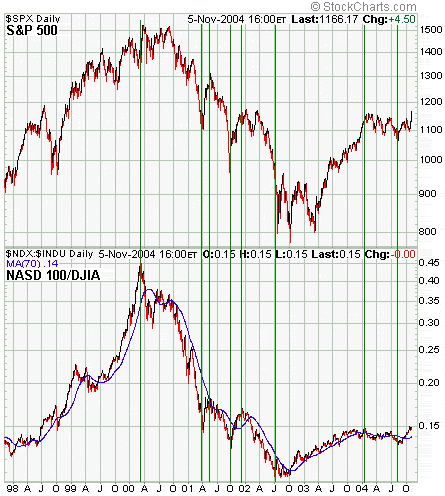
The above chart shows that
NDX/Dow was essentially trendless from the beginning of this
year until early September, which explains why it was so difficult
to get a handle on the market's intermediate-term trend during
the first 8 months of the year. In other words, one reason it's
been such a frustrating year for bulls AND bears is that this
simple indicator did not, prior to the past two months, provide
any clear signals. There were a couple of times when a breakdown
appeared to have occurred, most notably during the first half
of August, but in each case there was no follow-though.
However, over the past two
months the NDX/Dow ratio has provided a clear signal and the
signal is bullish. This wasn't, by the way, the only signal that
a bullish trend was developing; it was just the most important
one as far as we were concerned.
The fact that a bullish signal
occurred made (and still makes) very little sense to us, but
it would have made even less sense for us to ignore the clear
signs that the short- and intermediate-term outlooks were becoming
more positive. We therefore switched from 'intermediate-term
bearish' to 'intermediate-term neutral' on 8th September and
from 'short-term bearish' to 'short-term bullish' on 27th October
(2 days after the Dow's final low for the year). It's possible
that we will upgrade our intermediate-term outlook to bullish
within the next two weeks, but the fact that we haven't yet done
so reflects some on-going uncertainty with regard to the longevity
of the rally. Specifically, while the market appears to be headed
higher into January of 2005 we suspect that the January high
could turn out to be the high for the year because the monetary
and fiscal backdrops during 2005-2006 are likely to be far less
friendly than they have been over the past two years.
19 Nov, 2004
Steve Saville
email:
sas888_hk@yahoo.com
Hong Kong
Regular financial market forecasts
and analyses are provided at our web site:
http://www.speculative-investor.com/new/index.html.
One-month free trial available.
Copyright ©2002-2004
speculative-investor.com All Rights Reserved
321gold Inc

|